

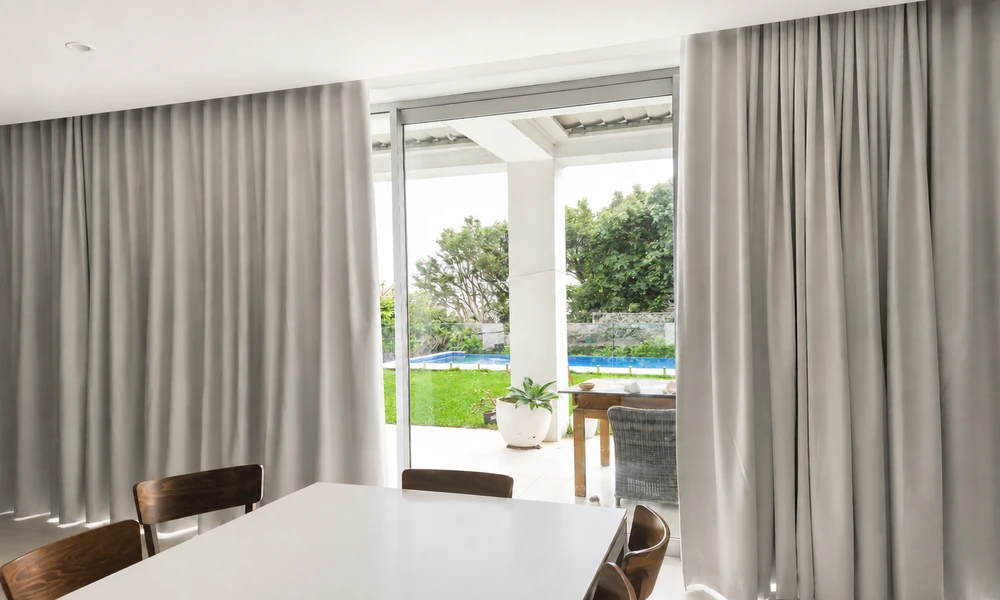
Living close to the city has a lot going for it. Cafes downstairs, the train a short walk away, and often a great old building with high ceilings and big windows. It also comes with neighbours a few metres away, streetlights shining into the bedroom and traffic or planes at all hours.
Curtains won’t fix all of that, but the right ones make a real difference to privacy, sleep and how secure a home feels. Here’s what to look for if you live somewhere dense and busy.
| The short answer Pair a sheer with a lined blockout on a double track for day and night privacy. Hang curtains ceiling to floor and well past the frame to stop light leaking in. Heavy lined curtains reduce noise a little and acoustic linings reduce it more, but no curtain will soundproof a room. |
|---|
Privacy is about the night as much as the day
In apartment blocks and converted warehouses, windows often face other windows across a lane or courtyard. During the day a sheer curtain gives decent privacy, because the outside is brighter than the inside. At night that flips. With lights on inside, people across the way can see straight through most sheers.
If a room faces the street or another building, plan for night-time privacy from the start:
- A sheer and a lined blockout on a double track gives you privacy by day and full cover at night.
- For ground-floor rooms on the street, put the blockout layer on the windows you use most in the evening, usually the living room and main bedroom.
- Run curtains past the edges of the frame so there are no gaps to see through at the sides.
There’s a security side to this too. Being able to close off a room completely means passers-by can’t see what’s inside, or tell when you’re home and when you’re not.
What curtains can and can’t do about noise
This is where expectations need to be realistic. No curtain will soundproof a room. Most outside noise comes through the glass, gaps around the frame and the walls, so if noise is the main problem, glazing and seals come first.
- Heavier, lined fabric absorbs more sound than a light sheer.
- Curtains that run ceiling to floor and past the frame cover more of the glass and the gaps around it.
- Fabric softens echo inside rooms with hard surfaces, which matters in warehouse conversions full of concrete, brick and timber floors.
Specialist acoustic linings go further. Testing in the University of Adelaide’s acoustics labs found curtains with an acoustic interlining could reduce perceived noise by more than half. They cost more than standard linings, but for a bedroom under a flight path or on a main road, they’re worth asking about.
A suburb where this comes up a lot
Sydney’s inner south is a good example. Alexandria has gone from industrial streets to warehouse lofts, Victorian terraces and new apartment blocks, and the wider Green Square area has been tipped to become the most densely populated part of Sydney. It’s also close to the airport and busy roads, and Sydney Airport acknowledges aircraft noise is a real concern for people living under the flight paths. Residents want privacy from close neighbours, darker bedrooms and a bit less noise, often all in the same room.

Matching curtains to the building
| Home type | Common issue | What usually works |
|---|---|---|
| Warehouse conversion | Huge steel-framed windows, echo, street views in | Full-height S-fold curtains on ceiling tracks, lined where privacy matters |
| Victorian terrace | Bedrooms right on the street, narrow tall windows | Lined blockout curtains hung high, pinch pleat or S-fold |
| New apartment | Floor-to-ceiling glass facing other units | Sheer and blockout on a double track, with concealed tracks |
Stopping light from outside
Streetlights, car headlights and the neighbours’ balcony lights are a bigger sleep problem than most people realise. A lined blockout curtain is the fix, but only if light can’t sneak around it. Mount the track close to the ceiling, extend it at least 10 to 15 centimetres past each side of the window and let the fabric reach the floor. A curtain that stops at the sill will always leak light.
If you’re comparing fabrics and linings, this guide to blockout curtains explains how they’re lined and where they work best.
Fitting into concrete and steel
Converted warehouses and newer apartments often have concrete ceilings and steel window frames. Tracks can be fixed into both, but it needs the right drill bits and fixings, so it’s worth using an installer who does it regularly rather than trying it as a weekend job.
Get it made for the window
Odd-sized industrial windows and very tall ceilings are exactly where ready-made curtains fall short. In Sydney’s inner south, Roma Blinds makes curtains to measure for Alexandria apartments, terraces and warehouse conversions, and is upfront that lined curtains help with noise but won’t soundproof a room.
Common questions
Can people see through sheer curtains at night?
Yes, when your lights are on inside. Add a blockout layer or a blind behind the sheer for night-time privacy.
Do blockout curtains reduce noise?
A little. Heavier lined curtains absorb some sound and soften echo, but they won’t stop traffic or aircraft noise. Acoustic linings do more.
How wide should curtains be to block light?
Run the track at least 10 to 15 centimetres past each side of the window, mount it close to the ceiling and let the curtain reach the floor.
Whoever you use, tell them what’s bothering you most, whether it’s being seen, streetlight or noise. The answer changes the fabric, the lining and how the curtain is hung.