

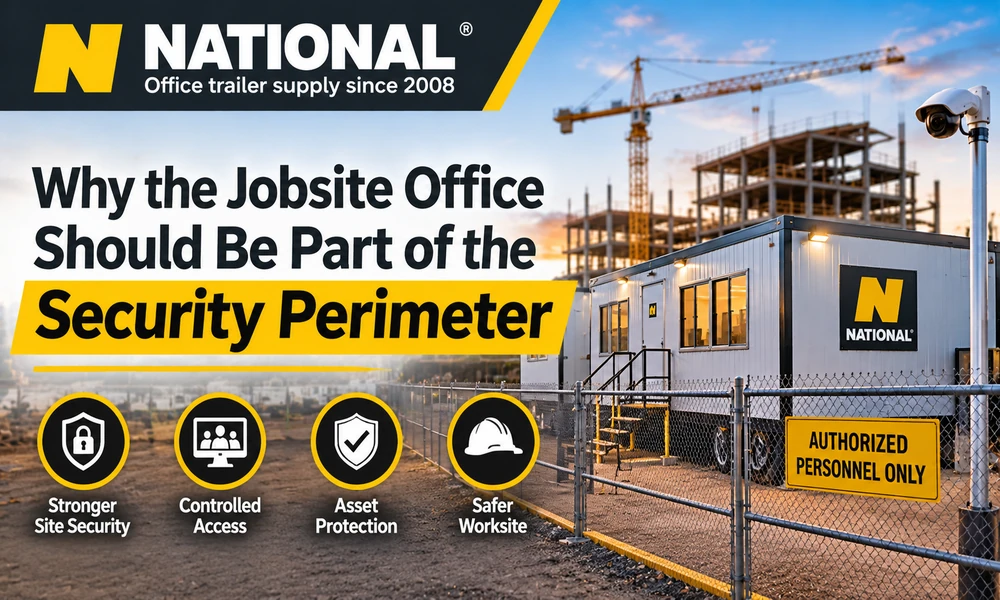
A construction office is often treated as a room that happens to sit behind the fence. In practice, it may hold the keys, access lists, laptops, drawings and schedules that explain how the entire site operates. That makes the office part of the security perimeter. Its location and daily routines can either support controlled access or create an easy path around it.
Near the main entrance, the office can give visitors, inspectors and deliveries a clear place to stop. A staff member can see who has arrived, confirm the reason for the visit and direct people without sending them through active work. The building should still sit outside truck lanes and equipment swing paths. Visibility helps only when the person approaching the door is not crossing a dangerous route.
Design the ordinary moments that defeat good security
Most weak points are not dramatic break-ins. They are a borrowed key that was never returned, a door propped open during a delivery or a visitor who followed someone inside. Decide who receives keys, who can copy them and what happens when one is lost. If electronic access is used, confirm that the door, power and communications in the proposed trailer can support the hardware before installation.
The reception position should see the entrance without placing key cabinets, schedules or computer screens in public view. Lockable storage is useful for credentials, devices and sensitive records. At the end of a shift, one named person should check doors, windows, files and equipment. A simple closeout routine is more dependable than assuming the last person will notice everything.
Exterior lighting is another practical layer. Staff arriving before daylight should be able to see the path, steps and anyone near the door. Trimmed sightlines and a clear approach reduce hiding places and help cameras capture useful views. If alarms or video are installed, determine who receives alerts and what action they are expected to take. Equipment without an owner quickly becomes decoration.
Security cannot create a bad entrance
A locked-down office still needs safe egress and a usable entrance. Steps and landings should be stable, illuminated and fitted with appropriate rails. Employees, inspectors and visitors may have different mobility needs. The guidance on planning an accessible mobile office is helpful because access, placement and security work best when they are planned together.
Security also depends on keeping the building in good condition. We can help address a damaged lock, broken window or building-mounted light before it becomes the new normal. Photographing the unit at delivery and routing concerns through one site contact creates a reliable maintenance path. A security routine works much better when the physical office supports it every day.
The same thinking applies when the site changes phases. Fences move, parking shifts and a once-quiet side of the office can become the main route for deliveries. We encourage the site team to revisit lighting, sightlines and visitor directions whenever the traffic plan changes. Security is not a drawing completed at mobilization. It is a habit of noticing when the property no longer works the way it did last month.
A few minutes spent walking the approach after dark can reveal more than a long checklist. You notice the burned-out fixture, the blind corner and the sign that cannot be read from a car. Those are fixable problems. When the office is treated as an active part of the perimeter, small corrections keep it useful without making daily access feel hostile.
National Office Trailer’s broader guide to jobsite safety and security can help teams carry these questions into site planning. The goal is not to turn a field office into a fortress. It is to make the place where people, keys and information gather strengthen the perimeter instead of becoming its softest point.
By the National Office Trailer team