

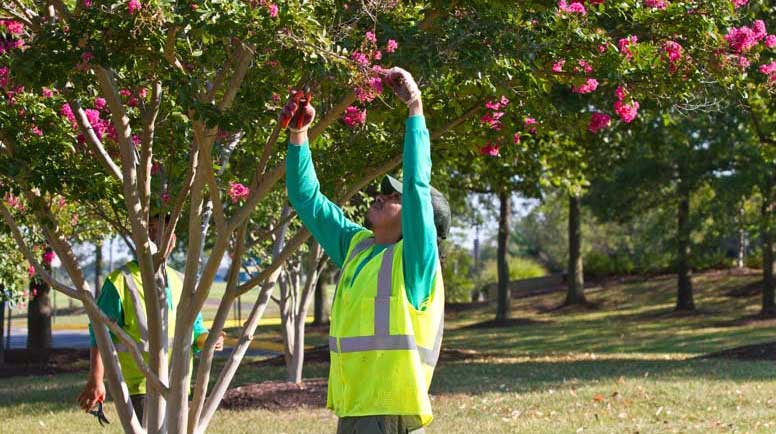
Most discussions about pruning focus on technique. Timing gets far less attention, yet it influences the result almost as much as where the cut is placed. Work carried out when a tree is already under stress recovers slowly and invites disease. Work delayed past the point where a defect is manageable turns a small job into a large one. Getting tree pruning timing right is largely about matching the intervention to the tree’s condition, the season and the risk it currently presents.
Urgent Work Has No Season
Some situations override every other consideration. A hanging or partially detached limb, a fresh crack in a major stem, a tree that has shifted after a storm, or growth in contact with electrical lines all need attention immediately regardless of the time of year. Damaged wood also provides an entry point for decay, so leaving it in place for months to wait for an ideal window causes more harm than acting promptly. Deadwood removal likewise can be done at any point, since dead tissue is not participating in the tree’s growth cycle.
Avoid Periods of Stress
For everything non-urgent, the guiding principle is to avoid cutting when the tree is already working hard. Extended dry spells, periods of extreme heat, and the peak of flowering or fruiting are all times when reserves are committed elsewhere. Pruning then diverts energy toward wound response that the tree cannot easily spare, and recovery is measurably slower. Newly planted specimens should receive only minimal corrective work for their first two seasons while they establish roots, and trees recovering from root damage or transplant shock deserve the same restraint.
Storm Preparedness
The most useful preventive scheduling happens ahead of periods of heavy weather rather than after. Reducing sail area on a top-heavy canopy, thinning dense growth so wind passes through rather than pushing against it, removing accumulated deadwood and addressing weak forks all lower the probability of failure when a squall arrives. Trees in exposed positions, those overhanging structures, and specimens with a history of limb loss should be prioritised. This is where planned work most clearly pays for itself, because the alternative is emergency response at premium rates with damage already done.
Frequency by Tree Age
Different life stages call for different intervals. Young trees benefit from formative attention every one to two years while their structure is still being established correcting competing leaders and narrow forks is trivial at this stage and nearly impossible later. Semi-mature specimens generally need work every two to three years. Mature trees usually require inspection annually but active pruning only every three to five years, since large cuts on old wood carry more risk than benefit. These intervals shift with species vigour and site conditions, so treat them as a starting point rather than a rule.
Signals That Work Is Due
Beyond the calendar, trees give indications that attention is needed. Branches touching or rubbing against a building, blocking a walkway, obstructing sightlines at a driveway or growing toward service lines are practical triggers. Visible deadwood, particularly larger limbs held within the canopy, is a direct hazard. A canopy that has become noticeably denser and heavier at the ends, or one casting so much shade that turf beneath has thinned despite a regular grass cutting service, indicates thinning would help. Any of these observations should prompt an assessment rather than waiting for the next scheduled round.
After Site Works
Construction, landscaping and service installation near trees create delayed problems. Roots severed during excavation reduce both anchorage and the tree’s ability to draw water, and the symptoms canopy dieback, undersized leaves, early leaf drop often appear one or two seasons afterwards. Any tree within the working area of a project should be inspected at completion and monitored through the following year. Where root loss is significant, reducing canopy load can help rebalance the tree, though this needs professional judgement rather than a general trim.
Coordinating With Other Grounds Work
Timing pruning alongside other maintenance saves money and prevents conflicts. Chipping debris on site is more efficient when access equipment is already present. Scheduling canopy work before a mowing round means falling material is cleared in the same pass rather than being shredded into the turf. Coordinating with the mowing round also allows protective mulch rings around trunks to be reinstated after machinery has been through, which prevents the strimmer damage that quietly kills young trees.
Confirm Permissions Before Booking
Substantial reduction or removal may need approval depending on the tree’s location, size and species, and penalties for proceeding without it are significant. This affects scheduling directly, because applications take time and work cannot start until consent is granted. Checking the requirements for tree cutting at the planning stage rather than the week before the crew arrives avoids delays and keeps the obligation, which sits with the property owner, properly discharged.
Building the Annual Cycle
A practical schedule looks like this, a full inspection once a year with a written record, deadwood removal as it is identified, preventive reduction and thinning ahead of the wettest and windiest months, formative work on young trees every one to two years, and reactive checks after storms or nearby excavation. Keeping this on a fixed calendar rather than responding to whatever looks worst means the work stays small, predictable and considerably cheaper than the alternative.