

Introduction: The part of the lift journey homeowners rarely question
When homeowners research a residential lift, the first questions are usually about price, space and installation. Energy use often comes later. Yet once a lift becomes part of everyday life, the electricity consumed during repeated journeys can matter.
The confusion is understandable. An elevator goes up and down, so it seems logical that the motor must keep working in both directions. With pneumatic vacuum technology, however, the movement is different. The system uses controlled air pressure to move the cabin, creating an operating cycle in which power is used for ascent while descent can take place without electrical power.
That is why the idea of power saving home elevators deserves a closer look. “Zero energy while descending” does not mean that the entire lift operates without electricity. It refers specifically to the descent portion of the operating cycle. Nibav’s Malaysia materials state that its air-driven home elevators use power for ascent and zero power for descent.
What does zero power during descent actually mean?
The simplest way to understand it is to separate a lift journey into two parts: going up and coming down.
During ascent, the pneumatic system uses electrical power to create the pressure difference needed to raise the cabin. Nibav states that its home elevators operate on a regular 3.7 kVA power supply and draw power while ascending.
During descent, the system uses air pressure and the controlled movement of the cabin rather than continuing to power the cabin upward. Nibav describes this as zero power consumption during descent.
So, if someone asks, “Does a Nibav lift use no electricity at all?” the accurate answer is no. The accurate statement is that Nibav’s system is designed to use electricity for ascent and zero power for descent.
That distinction is important for responsible SEO content and for homeowners comparing technologies. Energy efficiency should be explained precisely rather than turned into an exaggerated promise.
How pneumatic vacuum elevators create a different energy profile
Pneumatic vacuum elevators use pressure differences around the cabin. The technology is fundamentally different from a conventional traction lift or hydraulic lift.
The cabin moves inside a cylindrical structure, and controlled air pressure creates the movement required for vertical travel. Because the system does not rely on a conventional cable-and-counterweight arrangement, the energy demand is structured differently.
For a residential user, this matters because home elevators are generally used for short journeys between a small number of floors. The system does not need to handle the traffic volume of a commercial elevator in a shopping centre or office tower.
Energy saving elevator technology should therefore be evaluated in the context of actual home use. Look at:
· Power required during ascent
· Power required during descent
· Number of daily trips
· Number of floors
· Rated capacity
· Installation requirements
· Maintenance requirements
· Backup and safety systems
This broader view helps homeowners understand what they are buying instead of focusing on a single headline claim.
Who is looking for power saving home elevators?
The target audience is particularly relevant in Malaysia because home lift buyers are not one uniform group.
Families in duplexes and villas may use a lift several times every day, making operating efficiency a meaningful consideration.
Older homeowners and multigenerational families may want easier movement between floors while also thinking about the long-term suitability of the home. Malaysia is moving into an ageing society, increasing interest in home environments that support independence and safer everyday movement.
Homeowners renovating existing properties often have a second concern: avoiding unnecessary construction. A compact, pitless and machine-roomless lift can address both the mobility problem and the installation problem.
Eco-conscious homeowners may compare energy use as part of a wider preference for more efficient home technology.
Homeowners in Kuala Lumpur and other urban areas may also be especially sensitive to space, because a lift that requires a large dedicated service area can be difficult to accommodate.
Malaysia’s 2024 statistics show that 78.0% of living quarters were owner-occupied, giving many households a strong reason to think about long-term improvements to their homes rather than short-term convenience alone.
Nibav home lifts in Malaysia: efficiency without the conventional footprint
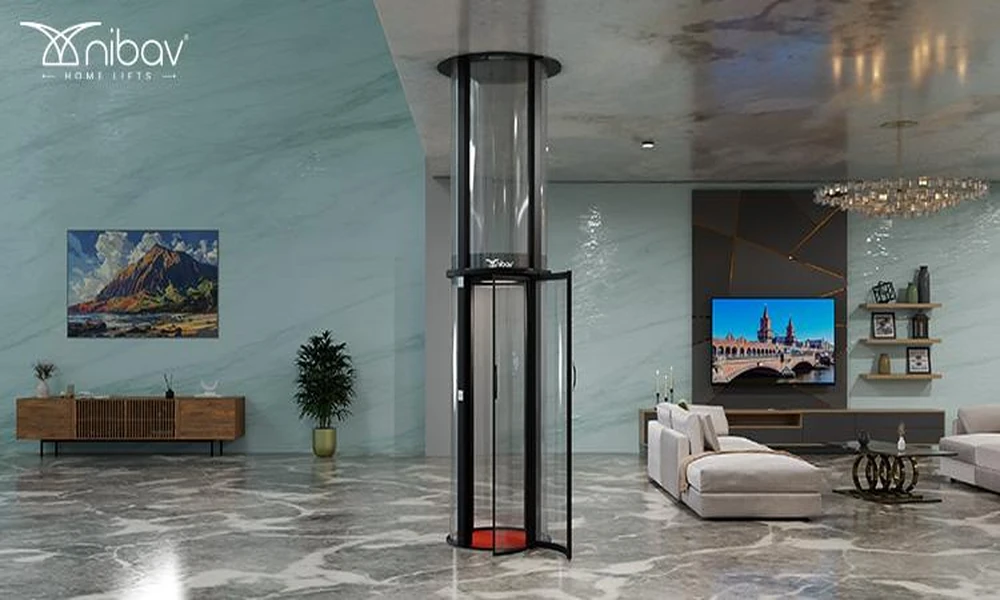
Nibav applies pneumatic vacuum technology to a residential product designed around compact installation. The Malaysia range emphasizes air-driven operation, no pit, no separate machine room and self-supporting construction.
The Series III Standard is one example. It is designed for compact residential settings, has a 210 kg capacity, can serve up to four stops and requires approximately 1010 mm of clear space. Nibav describes it as an energy-efficient home elevator that uses power during ascent and air pressure for descent.
The wider product range provides different cabin sizes and capacities. Series IV focuses on compact sophistication, while Series IV Max is designed for homeowners who want a larger cabin and higher capacity. Series V and Series V Max move further into premium design, personalization and spacious accessibility.
For Malaysian homeowners, the practical advantage is that energy efficiency is combined with a design intended for residential retrofit. Nibav says its home elevators do not require a traditional pit or machine room, helping reduce the construction burden of adding a lift to an existing home.
| Nibav Malaysia feature | Why it matters to homeowners |
| Pneumatic vacuum technology | Uses controlled air pressure for vertical movement |
| Power-saving descent | Nibav states zero power is used during descent |
| 3.7 kVA supply | Nibav states this is the regular power requirement for its home elevators |
| No pit / machine room | Reduces the conventional infrastructure needed for installation |
| Self-supporting design | Allows the lift to function as a standalone residential structure |
| Multiple model sizes | Lets homeowners choose according to space and capacity needs |
How to compare power saving home elevators before buying
Start by asking for the operating specification, not just a marketing phrase. A reliable comparison should explain how the system moves, when power is consumed, and what happens during a power outage.
Next, consider how often your family will use the lift. A lift used twice a day has a different usage profile from one used twenty times a day. Think about the number of occupants, floors, luggage, groceries, mobility aids and other everyday needs.
Then look at installation. Nibav’s Malaysia range is designed for pitless and machine-roomless installation, with prepared-site installation commonly described as 4 to 5 working days. The exact timeline depends on site readiness and the selected model.
Finally, look beyond electricity. Maintenance, safety, cabin size, warranty terms, after-sales support and customization all influence the long-term value of a home elevator.
Frequently Asked Questions
1. Do power saving home elevators really use zero energy while descending?
Nibav states that its air-driven home elevators draw power during ascent and zero power during descent. This applies to the descent portion of the journey, not the complete lift system.
2. Are pneumatic vacuum elevators more energy efficient than conventional lifts?
Their operating mechanism is different, and pneumatic systems can have a distinct energy profile. A fair comparison should consider ascent, descent, frequency of use, capacity and maintenance rather than one number alone.
3. What power supply does a Nibav home lift use in Malaysia?
Nibav states that its home elevators operate on a regular 3.7 kVA power supply.
4. Can Nibav power saving home elevators be installed in existing Malaysian homes?
Yes. Nibav designs its home lifts to be self-supporting and to install without a conventional pit or separate machine room, making them suitable for many existing homes and renovation projects.
5. Does zero-power descent mean the lift is unsafe during a power cut?
No. Nibav models include safety provisions such as emergency descent, backup lighting and other model-specific emergency systems. The exact features vary by series.
For a new purchase, it is also sensible to ask the installer to explain the rated capacity in practical terms. A 210 kg rating, for example, is a system specification, not a suggestion to load the cabin as close to that limit as possible. Families should follow the manufacturer’s instructions and avoid treating the overload alert as permission to exceed normal usage.
The best approach is simple: choose the correct model for the household, understand the rated capacity, and use the built-in safety systems as an additional layer of protection.